From System to Silicon: Tata’s Role in Expanding India’s Electronics Manufacturing Ecosystem
0
July 24, 2025
India’s semiconductor ecosystem is making significant strides due to India Semiconductor Mission and the Tata Group’s investment commitments of $14 billion toward a fabrication unit and ATMP plant.
Key beneficiaries of the fabrication unit may include Tata subsidiaries like Tata Motors and Tejas Networks, which have already signed an MoU with Analog Devices to enhance cooperation. Notably, Tata Motors held a 38% share of the Indian EV market in Q1 2025, according to Counterpoint’s Automotive Tracker .
The fab and ATMP unit will not only benefit Tata but also the target of achieving 35% domestic value addition in India’s electronics manufacturing ecosystem by 2030.
India has become self-reliant in smartphone production, while recording a 22% growth in exports in 2024, driven largely by iPhones made in India by Foxconn and Tata (through its partnership with Pegatron).
Involvement of both private and government sectors will create a local supply chain that can mitigate supply shocks and address security concerns.
As India’s electronics sector fires on all cylinders, semiconductors are shifting to the next gear, spearheaded by Tata Electronics, a subsidiary of the Tata Group, one of India’s leading conglomerates. Tata Electronics entered the semiconductor ecosystem in 2020 and quickly scaled up its investments.
Tata has been at the forefront of supporting India’s semiconductor push by committing $14 billion in investments to establish a fab at Dholera in Gujarat and an ATMP plant at Jagiroad in Assam. Together these projects represent over three-fourths of the outlay under the India Semiconductor Mission.
The fab facility will support process nodes up to 28nm with a production capacity of 50,000 wafers per month. The OSAT facility on the other hand will feature capabilities such as Wire-bonding, Flip-chip, Wafer-Level Packaging (WLP) and Integrated System Package (ISP).
These capabilities are expected to address Tata’s internal component requirements as well as external demand, and have the potential to unlock opportunities across India’s growing manufacturing ecosystem, especially as the government sets sights on 35% domestic value addition by 2030.
Source: Counterpoint Research
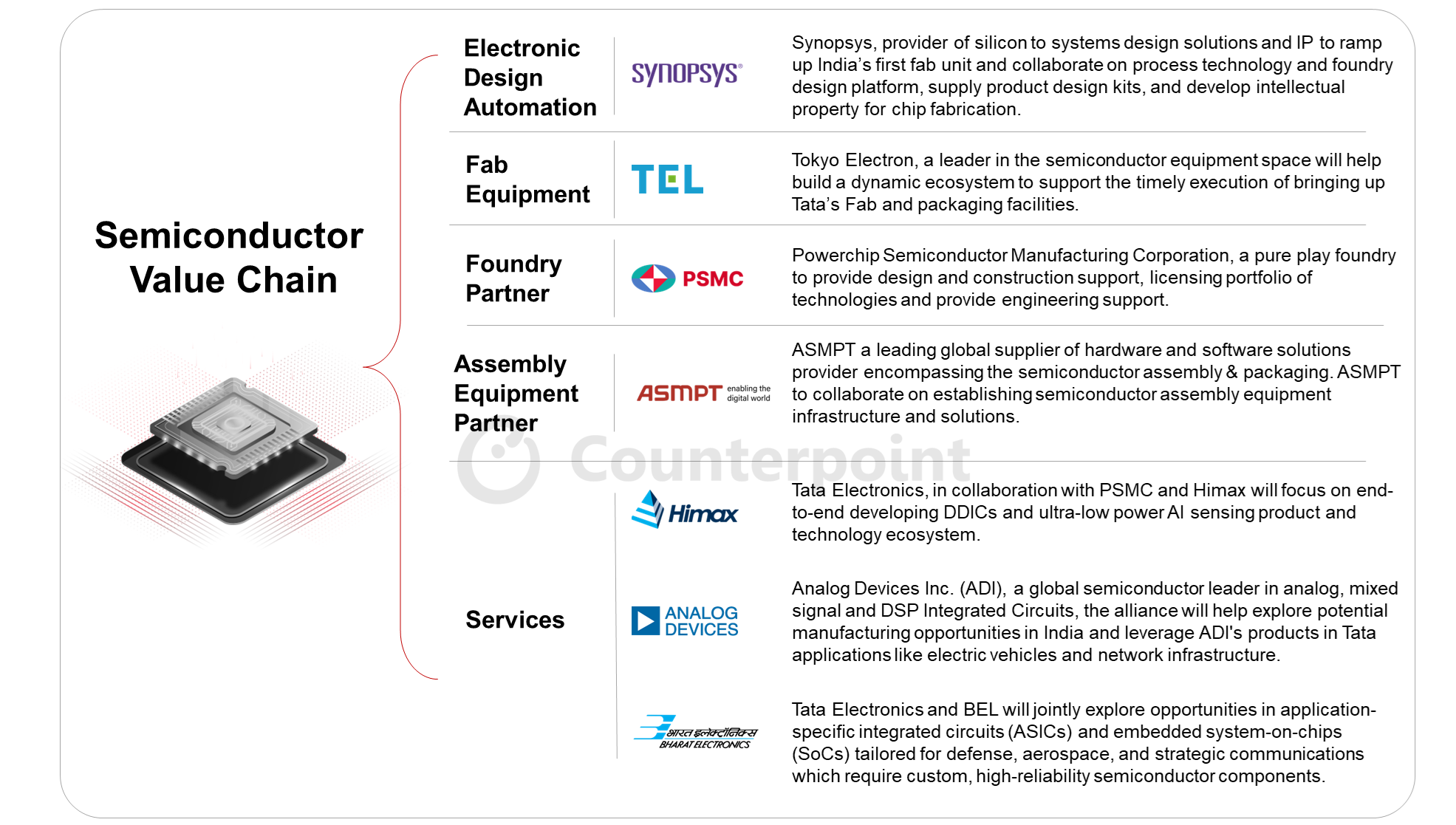
Tata’s Partnerships that have allowed it to establish the Semiconductor Ecosystem
Tata Electronics Partnerships Central to Establishing Semiconductor Manufacturing Ecosystem
Tata has been successful in bringing the partners and collaborations required to kickstart its semiconductor journey. It has managed to onboard technology partners, tool providers, equipment suppliers, IP vendors, solution vendors and IC design house to enable the setting up of production infrastructure. The result is that Tata has been able to establish India’s first semiconductor plant.
Receive our insightful weekly newsletter and stay ahead of the competition.